Mulu National Park

Mulu National Park, located in the state of Sarawak, is a unique tourist destination that has been recognized by UNESCO (United Nations Educational Scientific and Cultural Organization) as a World Heritage Park.
The mystery and wonder found around the location has also attracted the interest of scientists since it was first discovered. In 1978, the Royal Geographical Society launched one of the largest expeditions ever held in Mulu.
Mulu National Park is also a paradise for nature lovers and adventurers who like jungle trekking and mountain climbing.Visitors can see many species of flora and fauna in the Park.
Miri and Limbang are the two main entrances to Mulu National Park. From Miri, visitors can fly on scheduled Twin Otter flights operated daily by MAS or take express boats and motorized longboats to Mulu.
There is a nominal entrance fee for all National Parks in Sarawak. A photo permit is also required. Contact the National Parks and Wildlife office in Kuching or Miri to find out the final payment structure.
Batang Ai National Park

The greatest transnational protected area for the preservation of tropical rainforests includes Batang Ai National Park. Many endangered wildlife species, like the Borneo orang utan, have found refuge in these protected regions, which are close to the Lanjak-Entimau Wildlife Sanctuary in Malaysia and the Betung Kerihun National Park in Indonesia. In this sanctuary, there are thought to be more than 1,000 orang utans living. Only a portion of the Batang Ai National Park is accessible to visitors as part of conservation efforts, but those who do may be able to see a wild orang utan in its natural habitat. Visitors should be aware that although though the park has the largest orang utan population density in central Borneo, this does not ensure that they will see an orang utan.
Bako National Park
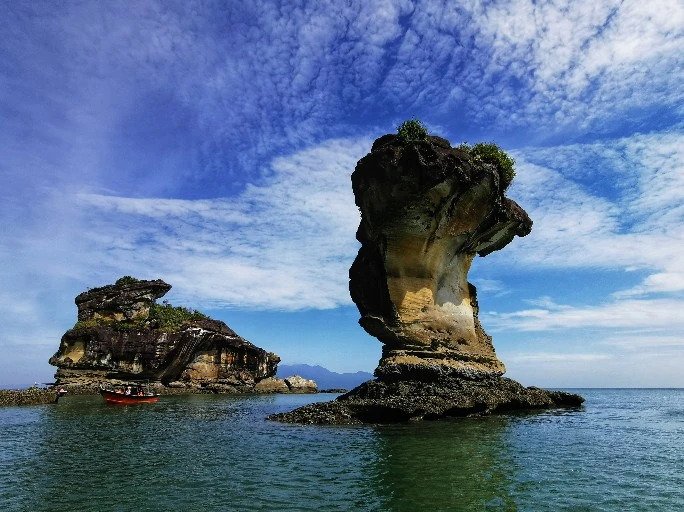
Bako National Park provides visitors with a great introduction to the Bornean rainforest thanks to its rainforest, abounding wildlife, jungle streams, waterfalls, rare vegetation, and trekking trails. Despite the fact that Bako lacks a well-known star attraction, it is obvious that there are very few locations in the world that compress as much natural beauty into such a little space, all of which are only 37 kilometers from Kuching. Bako is one of Sarawak's most well-liked parks due to its accessibility and wide variety of attractions and activities.
Tanjung Datu National Park

Tanjung Datu, one of Sarawak's smaller National Parks, is located on the westernmost part of the state's coastline. Tanjung Datu is stunning, and has been dubbed the 'Heaven of Borneo' by some visitors. However, it is only accessible by boat. The contrast of craggy mountains cascading down to a lovely blue sea is what makes the place so beautiful
Its swiftly running mountain streams, like the sea into which they flow, are crystal pure. This permits coral to grow near to shore, which is unusual in Sarawak, and makes it an ideal dive and snorkeling site, despite the fact that scuba divers have yet to fully explore the area's potential. Anyone, though, may appreciate the park's gorgeous beaches and crystalline waters set against a mountain backdrop.
Tanjung Datu is home to hornbills, and Rafflesia flowers, which are among the world's largest, thrive along the hiking routes. Beautiful vegetation and unusual creatures thrive in the mountains that constitute the boundary between Sarawak and Indonesian Kalimantan./p>
Tanjung Datu is home to hornbills and Rafflesia blooms, which are among the world's largest flowers.
The mountains that constitute the boundary between Sarawak and Indonesian Kalimantan are teeming with magnificent vegetation and fascinating fauna.
Fairy Cave

Most Sarawakians are familiar with Fairy Caves. Fairy Caves, located roughly forty kilometers from Kuching city and seven kilometers from Bau town, is one of the primary attractions in the Bau area.
Bau's Fairy Cave Legend - Bidayuh Community
The story begins with a poor boy and his mother in Kampung Kapur, a Bidayuh kampung near Fairy Cave. A Gawai ceremony was organized at one of the kampung households one day. The small child was inquisitive, so he went to see what was going on at the festival. This infuriates the owner. The cruel owner gathered some sugarcane debris and offered it to the youngster, telling him it contained pig.
The thrilled and happy boy returned home. He gave the "gift" to his mother, but she discovered nothing but sugarcane waste. She was so embarrassed and enraged that she vowed to exact her revenge.The mother grabbed a cat, gave it a lovely dress, and flung it into the middle of her neighbor's party. The image made the attendees start to laugh. Their laughter sparked a storm, which resulted in thunder, lighting, and a darkening of the sky. All of the villagers turned to stone after the storm passed, creating the stalagmites and stalactites in Fairy Cave.
According to a different version of the story, the youngster flung the cat into the middle of the party before covering his head with a chicken basket to protect himself from the curse.